
Why This Comparison Matters for Our Workflows
Choosing between a docking station and an eGPU changes how our laptop performs, how we work, and how we move. We want clear, practical guidance for productivity, creative workloads, and gaming.
We’ll give a side-by-side look focused on performance, portability, convenience, and cost. These criteria will guide comparisons in every section so we can pick the right accessory for our needs.
This article is hands-on and decision-focused — not just specs. By the end we’ll know which setup fits our workflows and why. We’ll include tests, real-world examples, and setup tips for immediate use.
Docking Stations and eGPUs: What They Are and How They Differ
Docking stations: hubs that extend our laptop
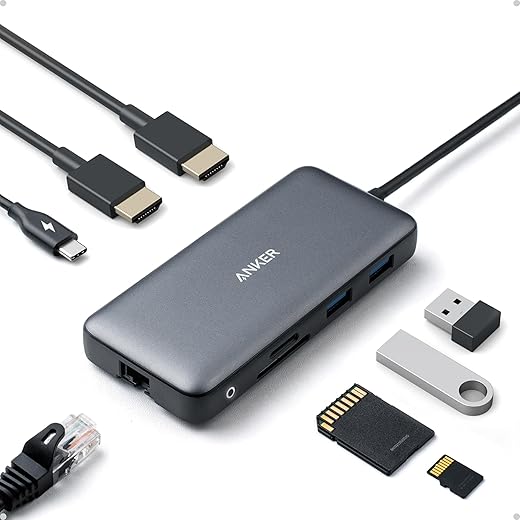
A docking station is essentially a smart hub that turns a single laptop port into a mini desktop. We can plug in displays, Ethernet, audio, USB peripherals, and get power back to the laptop (if the dock supports power delivery). There are two common dock types:
Typical port mix:
Real-world models to consider: CalDigit TS3 Plus, Anker PowerExpand Elite, Dell WD19.
eGPUs: external graphics over PCIe
An eGPU is an external enclosure that houses a desktop GPU and presents it to our laptop as a PCIe device. The enclosure provides power, cooling, and the PCIe interface; the GPU inside does the heavy graphical work. That makes eGPUs ideal when we need discrete GPU-level rendering, CUDA processing, or high-end gaming on a thin laptop.
Common enclosures: Sonnet eGFX Breakaway Box, and the .
Why connections and standards matter
The link between host and dock/eGPU is crucial. USB-C can carry data, video, and power, but only Thunderbolt 3/4 provides the full PCIe lanes and bandwidth an eGPU needs for near-native GPU performance. Practical tips:
Short checklist for immediate use:
Matching Solutions to Our Workloads: Productivity, Creation, and Gaming
Office & hybrid work — convenience-first
For email, spreadsheets, video calls, and multitasking we prioritize simplicity: one cable, multiple monitors, Ethernet, and reliable charging. A dock wins here every time — it turns our laptop into a tidy workstation without fiddling with external power bricks or adapters. Practical tips:
Content creation — when a dock is enough vs when an eGPU matters
For photo editing and light timelines a dock paired with a decent internal GPU often suffices: exports are fast enough and color grading is smooth on an external color-calibrated monitor. We consider an eGPU when:
Gaming, VR, and portable ML — performance-first with caveats
eGPUs can turn thin laptops into gaming/VR machines, but expect a bandwidth tax: Thunderbolt typically costs 10–30% performance vs internal PCIe, and laptop CPUs can bottleneck high-end GPUs. For VR, latency matters—test with your headset.Edge cases we’ve seen:
Spectrum quick-guide:
Performance, Bandwidth, and Power: The Numbers That Matter
Host interface: bandwidth realities
We start by accepting that the connection between laptop and peripheral is the choke point. Thunderbolt 3/4 gives us roughly 32 Gbps of PCIe-equivalent bandwidth (it’s essentially four PCIe Gen3 lanes tunneled over a 40 Gbps link). A desktop PCIe x16 slot is multiple times faster, so an external GPU will never quite match a native desktop card. Non‑Thunderbolt USB‑C can be far lower (10–20 Gbps) unless it supports USB4 at 40 Gbps—support that varies by model.
eGPU overhead & how to measure it
Expect a real‑world eGPU penalty in the 10–30% range for GPU‑bound 3D workloads, higher if frames are routed through the laptop’s iGPU (loopback). To quantify:
Quick tip: connect your external monitor to the eGPU enclosure—this often reduces the “loopback” tax.
Power delivery and thermal constraints
Docks typically provide 45–100W PD; that’s fine for office work but may not sustain heavy CPU+GPU loads on high-power laptops. eGPU enclosures include their own PSUs (300–750W) and cool GPUs better, but the laptop CPU still runs on its internal cooling — we’ve seen thermal throttling on thin laptops even with a beefy eGPU attached.
CPU, drivers, and latency-sensitive tasks
CPU bottlenecks kill potential gains: increase resolution or settings to move load to the GPU. Driver and OS support matter — Windows has strong eGPU ecosystems; macOS on Apple Silicon effectively blocks eGPUs. Security/BIOS Thunderbolt settings can prevent devices from enumerating. For latency-sensitive work (competitive FPS, VR, pro audio), test frame times, LatencyMon, or headset motion-to-photon latency—small overheads become noticeable.
Practical takeaway: measure the bottleneck with the tools above, match connection and power to the workload, then decide if the measured loss is tolerable for everyday use. Next we’ll look at how these performance realities play out in daily setup, portability, and user experience.
Everyday Fit: Setup, Portability, and User Experience
First plug: setup and the checklist we follow
The first time we bolt a dock or eGPU to a laptop sets the tone. Our quick checklist: update laptop BIOS/firmware, install vendor drivers, update the dock/eGPU firmware, confirm Thunderbolt security settings, and connect displays last. For many of us a CalDigit TS4 or Dell WD19TB will behave like a true “one-cable” desk, while a Razer Core X or Sonnet Breakaway Box needs the extra PSU and a little patience. Do these steps once and daily headaches drop dramatically.
Hot‑plugging and reliability in real life
Thunderbolt supports hot‑plugging, but apps that use the GPU or external drives can crash when you yank cables. We always:
Driver mismatches are the usual culprit. Stick to OEM drivers for docks/eGPUs, and avoid installing multiple dock managers at once.
Cable management and desk footprint
Docks tend to be compact (CalDigit, Belkin), tucking under the monitor stand. eGPU enclosures are bulky and often sit on the floor or beside the desk. Our cable tips:
Mobility and daily transitions
If we commute, a dock wins: unplug one cable and go. An eGPU is stationary; it’s fine if we leave the laptop at the desk, but we treat it as semi-permanent. For hybrid setups, we pair a compact dock for travel and keep the eGPU for heavy sessions.
Ergonomics and peripheral placement
Use monitor arms, place webcams on the top monitor, and route keyboard/mouse to the dock for minimal re-plugging. If we want true GPU acceleration for creative work, we plug primary displays into the eGPU; otherwise the dock handles multi-monitor productivity smoothly.
Cost, Upgrades, and Long-Term Value
Up‑front vs real total cost
We start by separating sticker price from real-world outlay. A mid‑range dock (CalDigit TS4, Dell WD19TB) typically runs in the $200–$400 band; a basic eGPU enclosure (Razer Core X, Sonnet Breakaway) is often $200–$350, but you must add a discrete GPU ($250–$900+ depending on model). That means an eGPU setup can quickly approach the cost of a compact desktop once you factor in the GPU and PSU.
Hidden extras that add up
Plan for these predictable add‑ons:
Upgrade paths and modular value
One big advantage of eGPUs is modular GPU swaps: we can upgrade the GPU later without replacing the enclosure. Docks rarely let you “upgrade” ports—at best we add a hub or another dock. Resale tends to favor GPUs (they’re traded, mined, gamed), while docks depreciate faster.
Compatibility pitfalls that cost us later
Watch for these traps:
Practical buying checklist (how we decide)
We keep in mind that short‑term savings (buying a cheap dock or older GPU) can create longer replacement costs, while modular eGPUs can extend lifecycle if our workloads will need faster GPUs down the road.
How We Decide: A Step-by-Step Buying and Setup Guide
Quick decision checklist
Before we buy, run through these yes/no checkpoints:
Buying tips — what to test or ask
When shopping online or in person, check these specifics:
Setup & configuration — docks
Setup & configuration — eGPUs
Troubleshooting quick fixes
Maintenance & upgrade habits
With this checklist and setup routine in hand, we’re ready to weigh the final trade‑offs and make our pick in the Conclusion.
Making the Call: Which Option Fits Our Needs
We pick based on priorities: if convenience, seamless docking, and portability top our list, a docking station wins; if desktop-class GPU power and future upgrade paths matter most, an eGPU is the right move. Balance cost vs. long-term value and remember bandwidth limits affect real-world gains.
List our top three priorities, try gear in person or via trial periods, and iterate—start simple and upgrade when needs become clear. The best choice is the one that reliably makes our daily work faster, smoother, and more enjoyable. Let’s build setups that reliably serve us.